
Funding for auto repair
Auto repair shop funding with every cost itemized
The cash cycle
Busy and slow months
Tax-refund season and summer road trips tend to fill bays from spring through August, and January is often slowest, though it varies by location and climate.
How money moves
Where the cash gets stuck
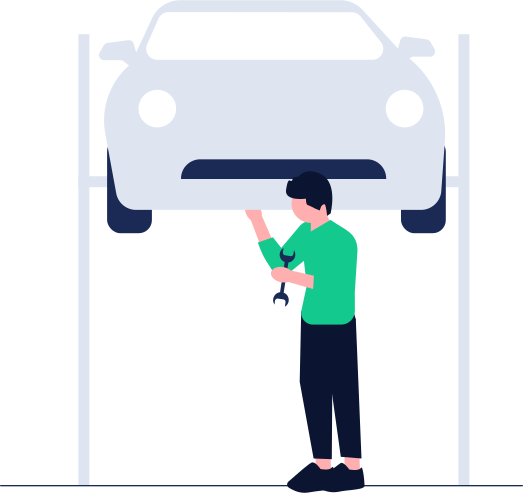
What owners use funding for
- Add a lift or an alignment machine
- Buy a scan tool or ADAS calibration equipment
- Pay down a parts account before it goes on hold
- Hire a tech and cover payroll until they're productive
- Add bays, a tire machine or a paint booth
- Carry fleet invoices that pay on terms
What fits
Funding that suits auto repair
Equipment financing
Lifts, alignment machines and ADAS targets are long-lived and secure their own financing, usually at a lower cost than an advance.
Merchant cash advance
Most retail tickets are paid by card, so split funding takes a set share of each batch and eases off when car count drops. Keep it for short needs.
Business line of credit
A line covers parts statements and payroll while fleet and insurance work is still unpaid, and you pay only on what you draw.
Underwriting
What funders check in auto repair
- Card batches and deposits over recent months
- Parts supplier accounts and whether they're current
- Fleet, warranty and insurance receivables, if you do that work
- Equipment you own and any existing equipment liens
- Whether you also sell vehicles
- Lease on the building and time remaining
Watch out for
A key tech or a DRP walks away
If 1 master tech bills most of your hours, or a body shop's volume rests on 1 insurer's direct repair program, losing either can cut revenue fast while payments keep running. Keep payments small enough to survive it.
Car sales on the side
3 funders we track exclude auto or used-car sales in their published criteria, and 1 of them makes an exception when the business also does repair work. If you sell cars too, say so up front.
Parts account holds
If a daily debit drains the account and your parts statement goes past due, suppliers can put you on hold and stop deliveries. That shuts bays faster than a slow week, so keep parts current ahead of any funding payment.
In depth
Financing scan tools and ADAS equipment
More repairs now need a scan tool, a calibration setup and the software subscriptions that keep them current. That's a big outlay for a shop that used to need a lift and a good set of tools. Newer vehicles may need calibration after a windshield, alignment or bumper job, which is where the volume comes from. Equipment financing spreads the hardware over its working life, with the equipment as collateral.
Software subscriptions often sit outside the financed amount, so add them to the monthly cost when you run the numbers. Our financing versus leasing guide covers when a lease makes more sense for technology that ages fast.
Split funding on repair orders
With split funding, your processor sends the funder a set share of each batch. A packed Friday sends more, and a slow January Tuesday sends less. That fits a shop better than a fixed ACH debit that takes the same amount whatever came through the door.
Fixed debits are common anyway. On $50,000 at a factor rate of 1.35 over 8 months, the debit is $401.79 each business day, and the total payback is $67,500. Openbook Capital shows that total, the cost in dollars and an estimated APR, about 95% on this example, next to every offer.
Fleet and insurance work won't run through your card processor at all, so a holdback only sees part of your revenue. If that share is large, a line may fit better than any advance.
Parts, fleet and the monthly statement
Your parts suppliers are, in effect, your first line of credit. Staying current keeps deliveries coming and can earn a better price.
Fleet accounts make it harder: you front the parts and labor, then wait for the fleet to pay on its terms. A line of credit drawn when a fleet invoice goes out and repaid when it pays usually costs less than carrying an advance through those weeks. If fleet work is growing, ask about invoice factoring for those accounts.
Before any funding, check what your top suppliers would do for you. A longer statement cycle or a higher credit limit on your parts account can cover a busy spring at no cost. Ask before you need it, since suppliers extend terms more readily to shops that pay on time.
Questions
Auto repair owners ask
Can I finance used or refurbished shop equipment?
Yes, many lenders finance used lifts and alignment machines, though some cap the equipment's age. Have the seller's invoice and serial numbers ready.
Is a body shop treated differently from a general repair shop?
Funders look at how you get paid. Body shops that rely on insurance-paid work have slower receivables, so a line or factoring may fit better than a daily-debit advance.
Do I need to own my building?
No. Most funders care more about your deposits and lease term than ownership. Buying your building opens longer-term options like an SBA 504 loan, which finances real estate and other major fixed assets.
Can funding help me buy another shop?
Yes. Buying an established shop is a job for an SBA 7(a) loan, which can fund a change of ownership and is repaid over years. An advance is a poor fit for an acquisition.
Can I pay off an advance early if car count picks up?
It depends on the contract. Some funders offer an early payoff discount, but many MCA contracts price the full purchased amount regardless. Get the payoff terms in writing before you sign.
Other industries
Sources
- 7(a) loans — U.S. Small Business Administration (checked 2026-09-30)
- 504 loans — U.S. Small Business Administration (checked 2026-09-30)
One application, many funders
Know the cost. Then decide
Tell us what you need in about 3 minutes. We compare funders that fit and show every offer with its total payback, dollar cost, payment and estimated APR.
- About 3 minutes. No SSN and no bank login to start, so checking doesn't affect your credit.
- 4 months of bank statements. A specialist contacts you within 1 business day and asks for them through a secure link.
- You approve every funder before your file goes out. No cost to apply, and no obligation to accept.